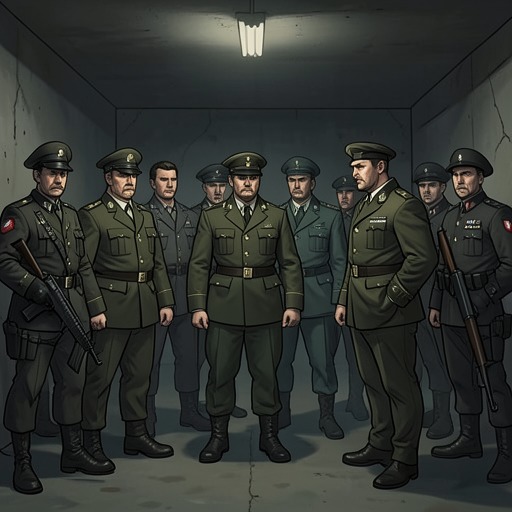
Bunker 3
The Zone of InterestBunker 3 is a red-brick, windowless building whose basement became the setting for a deadly assembly of Polish prisoners and whose yard witnessed their execution. The scene makes the place more than a backdrop: within its enclosed rooms, officials prepare and watch; outside, the prisoners’ numbers and brief resistance expose how precarious the authorities’ control could be.
Setting and Approach
At 6:28 in the morning, Paul Doll took his place behind a table in Bunker 3’s basement. Wolfram Prufer, Fritz Mobius, captains Drogo Uhl and Boris Eltz, and two agents from the Political Section were also present. A translator had been dismissed by Prufer, who judged that the Polish prisoners understood German well enough. The decision leaves the prisoners to face the proceedings without translation, while the officials control both the room and the terms of the encounter.
The officers’ composure is unsettled before the prisoners even enter. Doll had stayed up late drinking and had taken a sleeping drug shortly before the meeting; his vision blurred and rippled. Uhl hummed, Eltz lit a cigarette and stifled a yawn, and Mobius calmly arranged his papers. The basement’s controlled, official atmosphere thus sits alongside Doll’s physical disarray and the signs of strain among those gathered there.
The Assembly
The prisoners entered in columns of five, led by a single armed guard. Doll registered them as an unexpectedly imposing force: broad, muscular men whose striped uniforms strained against their bodies, some wearing real shoes. They continued to fill the space in successive groups, reaching at least three hundred before another man appeared. That final arrival was Bruno Brodniewitsch, a long-time collaborator whom the narration identifies as a despised former Pole.
Mobius called the prisoners to attention and announced that the Kommandant would speak. Doll then looked at the prisoners and reconsidered the balance of power in the basement. Although the German officers had pistols and the armed guard and Brodniewitsch carried light machine guns, he believed that if the assembled men sensed danger, even a small movement could leave no German alive. Bunker 3 therefore stages not simple confidence in authority but a moment in which the officials’ weapons coexist with their acute awareness of being outnumbered.
The Yard and the Executions
The violence followed later that day in Bunker 3’s yard. A small fraction of the Polish contingent chose to fight from a barricade, which was quickly overrun. The remaining 291 men were shot between 17:10 and 17:45. The shift from the packed basement to the yard turns the morning’s apprehension into a tightly timed mass killing; the building’s interior and exterior mark successive stages in the prisoners’ fate.
Afterward, Prufer described the operation as smooth and exemplary. The language of administrative appraisal stands against the concrete outcome: a brief barricade, overwhelmed, and hundreds of men killed in a span of thirty-five minutes. The scene does not give the site an aftermath of recovery or memorial; instead, it shows how readily the officers resumed their routines after the executions.
Narrative Significance
Bunker 3 is rendered through Doll’s compromised perspective, which binds the place to both the mechanics of the killing and his unstable perception of it. His blurred vision, the officials’ casual gestures, and his sudden recognition of the prisoners’ strength make the basement feel less like a secure command post than a room in which control is being tested. The yard then resolves that tension through overwhelming force, without erasing the resistance of those who fought.
The location’s force comes from this compressed geography: prisoners are marched into a windowless basement, displayed before the officers, and then killed in the adjacent yard. Bunker 3 gives administrative procedure a physical sequence and a boundary—assembly, apprehension, execution—while the contrast between the officers’ composed report and the prisoners’ destruction exposes the moral violence hidden by bureaucratic language.